
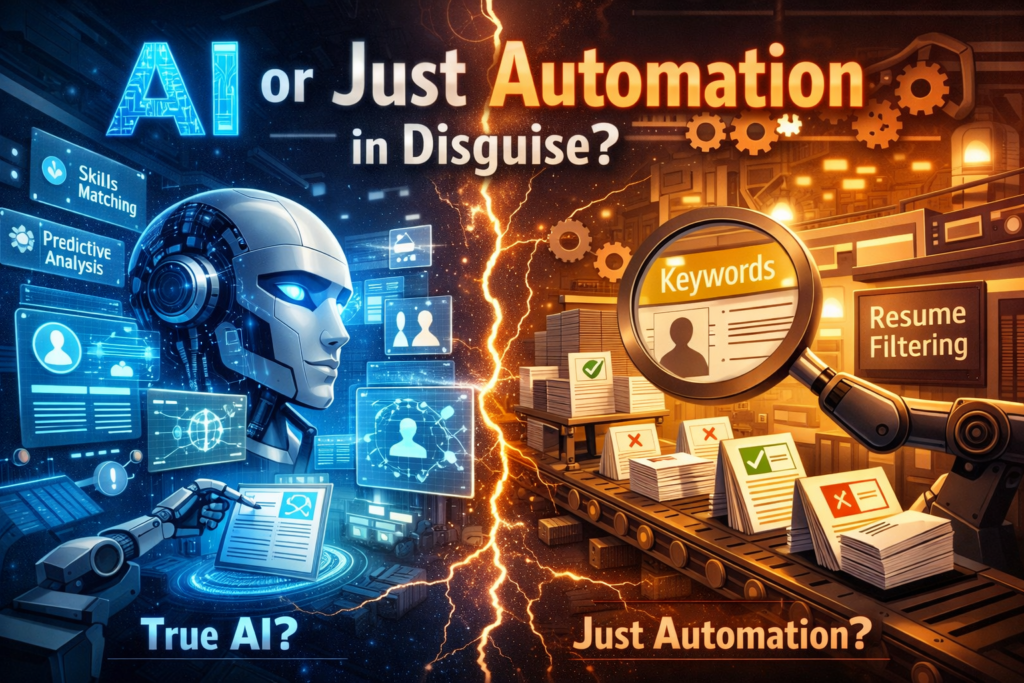
Artificial intelligence has become the buzzword of the recruitment industry. Nearly every HR technology platform claims to be “AI-powered,” promising faster hiring, better candidate matching, and reduced bias. But a closer look reveals an important question:
Are these tools truly AI, or are they simply automation tools rebranded as AI integration?
Understanding the difference matters—because how we label and use these technologies directly impacts how companies identify and evaluate talent.
The Difference Between AI Tools and Automation in Recruitment
Many recruitment platforms operate on a spectrum between basic automation and true artificial intelligence.
Automation Tools
Automation tools perform predefined tasks using rules and workflows. They make hiring processes faster but do not “learn” or improve from data.
Common automation features include:
- Resume keyword filtering
- Automated email responses
- Interview scheduling
- Candidate pipeline tracking
- Workflow routing inside ATS systems
Most Applicant Tracking Systems (ATS) fall into this category. Their core purpose is to manage hiring workflows such as posting jobs, tracking applications, and scheduling interviews rather than making intelligent decisions.
Automation can save time, but it does not actually evaluate talent in a meaningful way.
True AI Tools
True AI tools use machine learning, natural language processing, or predictive analytics to analyze large datasets and identify patterns that humans may miss.
Examples of AI capabilities include:
- Predictive candidate matching
- Skills inference (identifying skills not explicitly written)
- Behavioral or cognitive assessments
- Predictive retention modeling
- AI-driven interviews or conversational assistants
Modern AI hiring platforms aim to analyze, predict, and optimize hiring decisions, rather than simply track candidates.
Recruitment Platforms Using True AI
Below are examples of platforms that incorporate genuine AI capabilities beyond simple automation.
Eightfold AI (recently in the news for unethical screening issues using AI)
Eightfold AI is a talent intelligence platform that uses deep learning to match candidates to jobs based on skills, career paths, and potential—not just resume keywords. It can even identify hidden candidates and predict internal mobility opportunities.
Key AI capabilities:
- Deep-learning skill matching
- Predictive career pathing
- Talent graph analysis
- Workforce planning insights
HireVue
HireVue uses AI in video interviews and assessments to analyze responses, evaluate competencies, and standardize early-stage screening for large-scale hiring.
AI capabilities include:
- AI-driven video interview analysis
- Game-based cognitive assessments
- Predictive scoring models
These tools allow organizations to screen candidates consistently and at scale.
Pymetrics
Pymetrics uses neuroscience-based games and AI models to evaluate candidate cognitive and emotional traits. Instead of relying on resumes, the platform assesses behavioral patterns and job fit.
Key AI features:
- Behavioral modeling
- Soft-skill matching
- Bias mitigation algorithms
Paradox (Conversational AI)
Paradox focuses on AI-driven candidate engagement through conversational assistants that interact with candidates in real time.
These AI assistants can:
- Conduct initial screening conversations
- Schedule interviews automatically
- Answer candidate questions
The platform has processed millions of AI-driven candidate interactions globally.
Recruitment Platforms Primarily Using Automation
Many well-known recruitment systems marketed as AI are actually automation platforms with limited AI features.
Examples include:
Greenhouse
- Primarily an ATS platform focused on structured hiring workflows and candidate tracking.
Zoho Recruit
- Offers workflow automation, job posting, and resume parsing but relies heavily on rule-based filtering.
Freshteam
- Focused on automation such as scheduling, job postings, and workflow management rather than predictive AI.
Lever
- Combines ATS and CRM functionality with automation and reporting tools.
These tools improve efficiency but still rely heavily on keyword-based resume screening and manual recruiter evaluation.
The Resume Screening Problem: AI Without AI Resumes
One of the most overlooked risks in modern recruiting technology is an imbalance between AI screening and human resume writing ability.
Today, many companies use automated or AI-assisted systems to screen resumes before a human recruiter ever sees them.
But this creates a structural problem.
The reality of resume screening
When automated systems filter candidates:
- They prioritize keywords
- They favor structured resume formats
- They reward optimization rather than experience
This means candidates with strong skills but weaker resume writing ability may never reach a recruiter.
When Technology Screens Out Talent
Consider the mismatch:
Recruiters use:
- AI resume screening tools
- Automated ranking algorithms
- Keyword-based ATS filters
Candidates submit:
- Human-written resumes
- Often inconsistent formatting
- Different terminology for the same skills
The result is a filtering process that evaluates resume writing ability instead of professional capability.
Some industry experts have already warned about the growing automation in hiring processes. Surveys show the vast majority of hiring teams now use AI tools for tasks such as resume analysis and screening.
However, if the system primarily relies on textual signals from resumes, great candidates may be filtered out simply because they didn’t write their resume in the “right” way.
The Emerging Arms Race: AI Resumes vs AI Screening
We are now seeing the beginning of a new cycle:
- Companies deploy AI screening tools.
- Candidates start using AI to write optimized resumes.
- Screening algorithms evolve to detect AI-generated resumes.
- Candidates develop more advanced AI-assisted applications.
This could turn recruitment into an optimization game instead of a talent discovery process.
A Better Approach: AI-Assisted Discovery, Not Just Filtering
The future of AI in recruitment should focus less on filtering resumes and more on discovering potential.
More advanced AI systems already attempt this by:
- Inferring skills from experience
- Mapping career trajectories
- Identifying transferable skills
- Predicting job success beyond keywords
Platforms like Eightfold AI and Pymetrics are moving toward this skills-based hiring model, which reduces dependence on resume formatting.
Final Thoughts
The recruitment industry is currently experiencing an AI labeling problem.
Many tools marketed as AI are simply automation platforms designed to streamline administrative tasks. True AI systems—those capable of learning, predicting, and understanding skills—are still relatively rare.
At the same time, companies must be cautious about how they use AI in hiring. If organizations rely heavily on automated resume screening while candidates submit human-written resumes, the hiring process may unintentionally filter out strong talent.
Ultimately, the goal of recruitment technology should not be to process more resumes faster—but to identify the right people more accurately.
And that requires more than automation.
It requires real intelligence.
Key References on AI
1. Adoption of AI in Recruitment
Several industry reports show that AI and automation are already widely used in hiring.
- 87% of companies use AI in recruitment processes.
- 99% of Fortune 500 companies use AI-driven hiring tools.
- 65% of recruiters rely on AI regularly in their work.
- 73% of organizations use AI to screen resumes.
- 93% of recruiters use Applicant Tracking Systems (ATS) for hiring workflows.
2. Market Growth of AI Recruiting Technology
- The AI recruitment market reached about $661 million in 2023.
- It is projected to grow to $1.12 billion by 2030.
- AI can reduce cost-per-hire by 20–40% and improve hiring efficiency.
3. Automation in Resume Screening
- 90% of employers use automated systems to filter job applications.
- AI is used heavily for candidate sourcing (81%) and resume screening (73%).
- 96% of hiring professionals report using AI in recruitment tasks, including resume analysis.
- Example citation text
4. Risks of AI Screening and Candidate Concerns
- 66% of job seekers say they avoid applying to jobs that use AI screening.
- 35% of recruiters worry AI could exclude candidates with unique skills.
5. AI Resume vs AI Screening Bias (Academic Evidence)
Academic research supports the argument that AI screening systems may favor AI-generated applications.
- AI hiring models show self-preference bias of 68–88% toward AI-generated resumes.
- Candidates using the same AI system as the evaluator were 23–60% more likely to be shortlisted.
6. Candidate Behavior and AI Application Trends
- Job applications increased 45% due to AI-generated resumes, with 11,000 applications per minute submitted on LinkedIn globally.
I found this article from “All About AI” which had some good infographs and data related to how companies and candidates are using AI.
Some links for additional reading: https://www.allaboutai.com/resources/ai-statistics/ai-recruitment/?utm_source=chatgpt.com
What are your thoughts as a hiring manager, recruiter or candidate in this AI centric market? Share your thoughts in the feed.